
Episode 36: Pitch Your Ideas Part 2: Presenting the Body of Your Proposal
 Listen on Apple Podcast
 Listen on Spotify
Transcript
Hi there, and welcome back to Business English Made Easy! I’m Victoria, and today we’re covering Part 2 of our multi-episode series on pitching your ideas.
In the last episode, we focused on crafting a powerful opening—how to grab attention, set the context, and establish credibility. If you haven’t listened to it yet, I recommend going back and starting there, because your introduction sets the tone for everything that follows.
Today, we’re tackling the heart of your pitch: the body of your proposal. This is where you lay out your idea, support it with evidence, and make your case in a way that’s clear, logical, and convincing.
Here’s what we’ll cover in this episode:
1. How to structure the body of your pitch for maximum impact.
2. Key phrases and language to explain your idea and back it up.
3. How to anticipate and address objections so your audience stays on board.
Let’s dive into the details and make your pitch unforgettable.
Why the Body of Your Pitch Matters
The body of your proposal is where you prove that your idea is worth considering. It’s where you turn attention and interest into understanding and agreement. A strong body should do three things:
1. Clearly define the problem or opportunity you’re addressing.
2. Present your solution in a way that’s easy to follow.
3. Support your idea with data, examples, or logic to make it compelling.
If the introduction is about grabbing attention, the body is about building trust and credibility.
Step 1: Define the Problem or Opportunity
Before presenting your solution, you need to show your audience why it’s necessary. This step helps them understand the context and makes them more open to your proposal.
Example:
• One of the biggest challenges we’re facing right now is inefficiency in our supply chain. Delivery times have increased by 20% over the past year, which has frustrated customers and increased costs.
Use clear, measurable facts to outline the issue. If your pitch is focused on an opportunity rather than a problem, frame it like this:
• Our competitors are moving quickly to adopt AI-driven tools, and we have a chance to position ourselves as an industry leader by implementing this technology now.
Language to use:
• The problem we’re addressing is…
• The opportunity here is…
• This is important because…
Step 2: Present Your Solution
Once you’ve defined the problem or opportunity, introduce your solution. Be specific and concise, focusing on how it directly addresses the issue.
Example:
• To address this, I’m proposing a new inventory management system that uses predictive analytics to streamline our supply chain. This will reduce delivery times by 30% and save us $500,000 annually.
When presenting your solution, break it into manageable parts so your audience can follow along. For instance, you could say:
• There are three key elements to this plan: improving forecasting accuracy, automating warehouse operations, and negotiating faster shipping contracts.
Language to use:
• Here’s the solution I’m proposing…
• This approach focuses on…
• Let me break this down into three parts…
Step 3: Support Your Proposal with Evidence
Ideas without support can feel like guesswork, so this is where you need to bring in evidence. Use data, case studies, or examples to show why your idea works.
Example:
• Companies that have implemented similar systems have seen delivery times decrease by 25% within the first year. For example, XYZ Corp. adopted this system last year and reported a $1 million savings.
If you don’t have external data, rely on logic or projections:
• Based on our current shipping volume, reducing delivery times by even 10% would save us approximately $200,000 per quarter.
Language to use:
• According to industry data…
• This has worked for similar companies, such as…
• Our projections show that…
Step 4: Anticipate and Address Objections
Strong pitches don’t avoid objections—they address them head-on. Anticipating concerns shows you’ve thought through your proposal and helps build trust.
Example:
• I know one concern might be the upfront cost of implementing this system. However, the initial investment will be offset within the first six months through cost savings.
Another example:
• Some might wonder if this approach is too risky. While change always carries some risk, the benefits far outweigh it, and we can minimize challenges by rolling this out in phases.
Language to use:
• You might be wondering…
• One potential concern is…, but here’s how we’ll address it.
• I understand this raises questions about…, and here’s why it’s worth pursuing.
Example of a Strong Body
Let’s put it all together:
The problem we’re addressing is inefficiency in our supply chain. Over the past year, delivery times have increased by 20%, frustrating customers and raising our costs. To solve this, I’m proposing a new inventory management system that uses predictive analytics to streamline operations. This approach focuses on three areas: improving forecasting, automating warehouse tasks, and renegotiating shipping contracts. Companies that have adopted similar systems, such as XYZ Corp., have reduced delivery times by 25% and saved over $1 million annually. While there’s an upfront cost of $200,000, we project that it will pay for itself within six months through savings and increased customer satisfaction. I know the investment may seem significant, but we can mitigate risk by rolling it out in phases to ensure a smooth transition.
Your Challenge
This week, think about a pitch you’re working on. Write out the body of your proposal, starting with the problem or opportunity, presenting your solution, supporting it with evidence, and addressing objections. Practice delivering it aloud to refine your tone and flow.
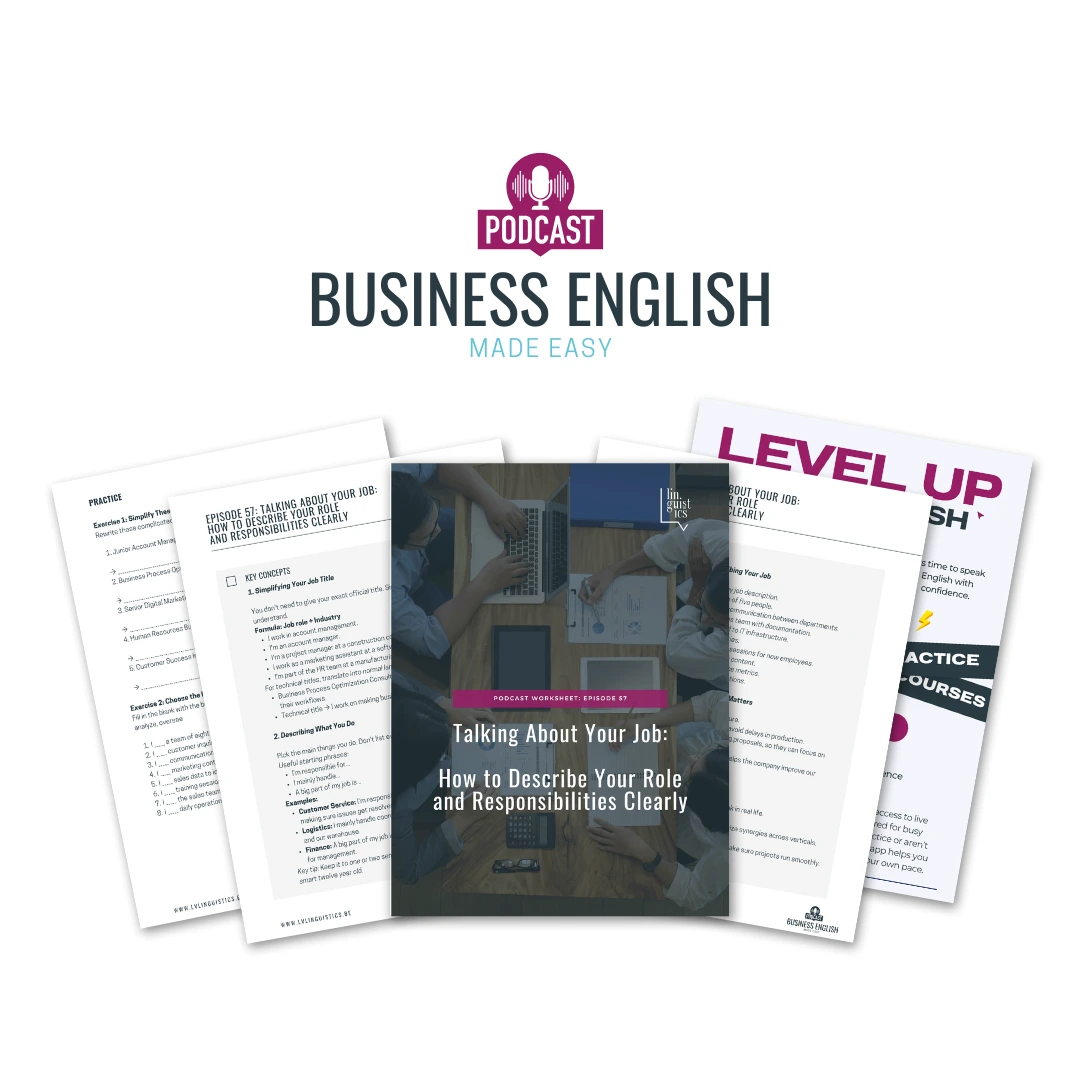
If you need guidance, I’ve created a worksheet to help you organize and develop your ideas. You can download it at the top.
What’s Next?
In the next episode, we’ll cover closing your pitch with impact. You’ll learn how to leave a lasting impression, create a clear call to action, and ensure your audience is ready to take the next step.
If you found this episode helpful, share it with a colleague or friend who’s looking to improve their pitching skills. And don’t forget to grab the worksheet for extra practice.
Thanks for listening to Business English Made Easy! I’ll see you next time!

Tous vos outils pour progresser en anglais pro, réunis ici.
Exercices, fiches pratiques et support – tout dans une application conçue pour vous accompagner.
Découvrez l'application