
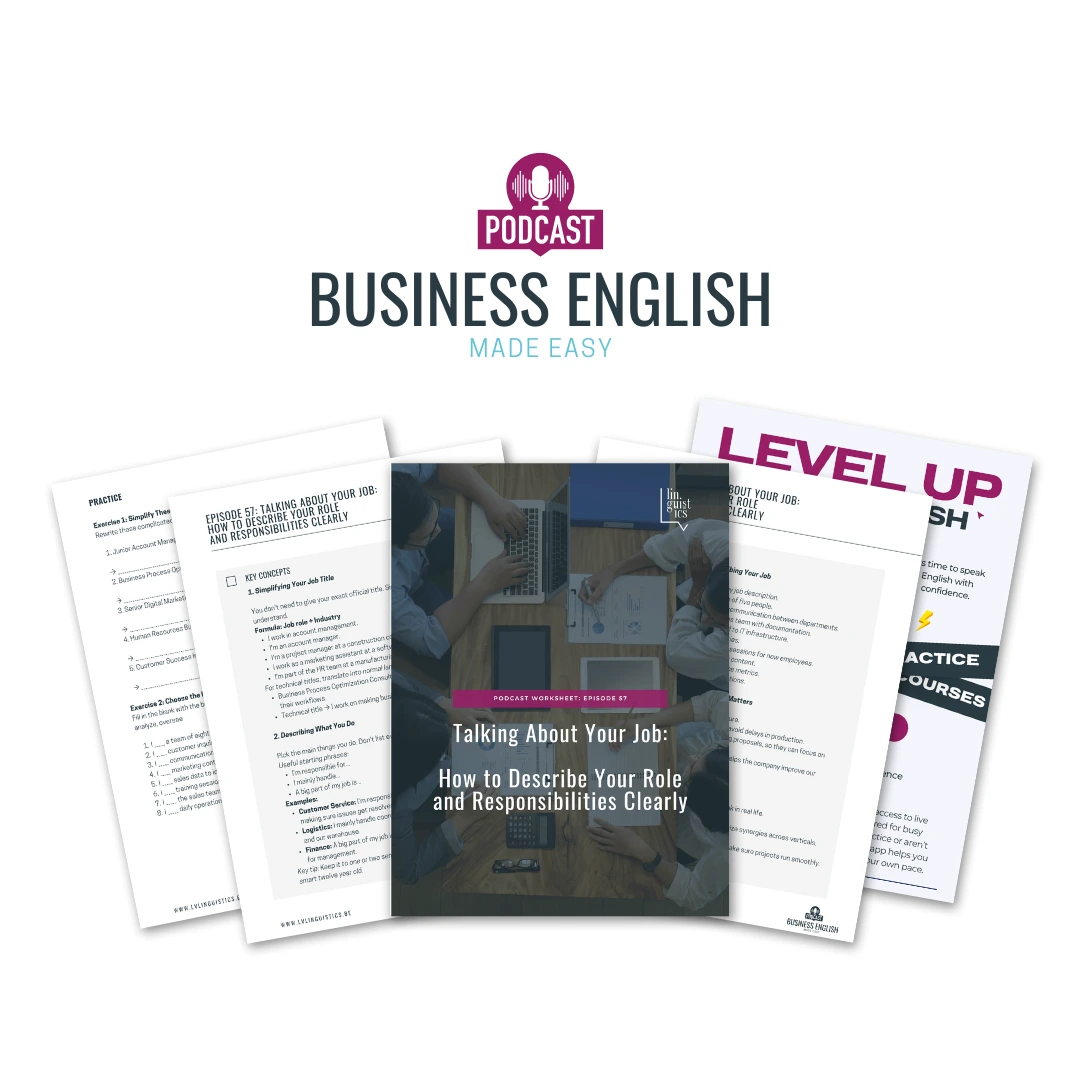
Episode worksheets are now exclusively available to Level Up members. Get this one and the full library when you join.
E.57: Talking About Your Job: How to Describe Your Role and Responsibilities Clearly
Rédigez un ou deux paragraphes décrivant votre produit, vos services ou une fonctionnalité spécifique.
Pour que votre contenu ait du succès, il doit être utile à vos lecteurs.
 Listen on Apple Podcast
 Listen on Spotify
Transcript
Hey, welcome back to Business English Made Easy. I’m Victoria Landa, founder of LV Linguistics. We’ve been doing corporate language training for over 11 years now, working with professionals all over the world who need English for their jobs.
And that’s what this podcast is all about. Real workplace communication that actually works. Not textbook English, not grammar drills. Just the phrases and skills you need to sound confident and professional at work. Every episode comes with a free worksheet you can download at lvlinguistics.be, and today’s is episode 57.
So I was at a networking event a few weeks ago, and I watched this happen. Someone asked a woman what she did for work. Simple question, right? She froze. Started stumbling through this long explanation about her department structure and reporting lines. By the time she finished, the person who asked looked confused, and she looked embarrassed.
This happens all the time. You know what you do. You do it every day. But when someone asks you to explain it in English, suddenly your mind goes blank. Or you overthink it and end up giving way too much detail.
Today we’re going to fix that. I want you to have a clear, simple way to talk about your job. Something you can use when you’re introducing yourself in a meeting, when you’re networking, when someone asks what you do. No fumbling, no overexplaining.
Let’s start with the basics. Your job title.
Job titles are weird because they’re different at every company. What one place calls a “senior associate” another place calls a “team lead” or a “specialist.” It can get confusing fast.
The good news is, in conversation, you don’t need to give your exact official title. You can simplify it. Make it something anyone would understand.
Instead of saying “I’m a Junior Account Management Specialist,” you could just say “I work in account management.” Or “I’m an account manager.” Same idea, way easier to understand.
If you work at a specific type of company, add that. “I’m a project manager at a construction company.” “I work as a marketing assistant at a software firm.” “I’m part of the HR team at a manufacturing company.”
That’s it. Job role plus industry. Simple formula that works every time.
Now, what if your job title is really specific or technical? Like you’re a “Business Process Optimization Consultant” or something. Nobody outside your company knows what that means.
Translate it into normal language. “I help companies improve their workflows.” “I work on making business processes more efficient.” That’s what people actually need to know.
And, when you’re talking about what you actually do, you don’t need to list every single task you do. That’s boring and people stop listening. Pick the main things. The stuff that takes up most of your time or the stuff that actually matters.
You can start with phrases like “I’m responsible for” or “I mainly handle” or “A big part of my job is.”
Let me show you what this looks like. Say you work in customer service. You could say “I’m responsible for handling customer complaints and making sure issues get resolved quickly.”
Or maybe you’re in logistics. “I mainly handle coordinating shipments between our suppliers and our warehouse.”
If you work in finance, maybe “A big part of my job is analyzing budget data and preparing reports for management.”
Notice these are all one or two sentences. You’re giving them the core of what you do without drowning them in details.
Here’s another way to think about it. Imagine explaining your job to a smart twelve year old. You wouldn’t use a bunch of jargon or internal company terms. You’d say it in plain language. That’s what you want to do in English too, especially if you’re talking to people outside your company or your industry.
There are some verbs that come up over and over when people talk about their jobs. It’s worth knowing these.
Manage. Coordinate. Support. Lead. Handle. Organize. Develop. Analyze. Oversee.
These are super flexible. You can plug them into almost any job description.
“I manage a team of five people.” “I coordinate communication between departments.” “I support the sales team with documentation.” “I lead projects related to IT infrastructure.” “I handle client inquiries.” “I organize training sessions for new employees.” “I develop marketing content.” “I analyze performance metrics.”
See how those work? Pick the verbs that fit what you actually do, and build simple sentences around them.
Sometimes it helps to add a bit of context about why your work is important. Not in a boastful way, just connecting what you do to the bigger picture.
Like “I manage inventory, which helps us avoid delays in production.” Or “I support the sales team by preparing proposals, so they can focus on meeting with clients.” Or “I analyze customer feedback, which helps the company improve our products.”
That extra piece shows you understand how your role fits into the organization. Makes your explanation more interesting.
One thing we see a lot with our corporate clients is they use way too much internal jargon when they describe their jobs. They’ll say things like “I interface with stakeholders to optimize synergies across verticals.”
Stop. Nobody talks like that in real life. And if English isn’t your first language, trying to use all that corporate speak just makes things harder.
Say it simply. “I work with different departments to make sure projects run smoothly.” Same meaning, actually understandable.
Let me show you how this all comes together. Imagine you’re in a meeting and someone asks you to introduce yourself.
“Hi, I’m Stefan. I work as a logistics coordinator at a manufacturing company. I’m responsible for managing shipments and working with suppliers to make sure our delivery process stays on schedule.”
That’s good. Clear job title, brief explanation of the main responsibilities, easy to understand.
Or maybe “Hi, I’m Maria. I’m part of the customer service team at a tech company. I mainly handle resolving technical issues for our clients and making sure they have a good experience with our products.”
Professional, confident, concise. That’s what you’re aiming for.
Now something that comes up a lot. What if you do a bunch of different things? What if your job is really varied and you’re not sure how to capture it in a few sentences?
Pick the most important parts. Or pick the parts that are most relevant to who you’re talking to. You don’t have to mention everything.
If you’re at an industry conference and everyone there works in supply chain, maybe you emphasize that part of your role. If you’re in a general networking situation, keep it broad.
You can also say something like “I wear a few different hats” or “My role covers a few different areas.” Then mention the main ones. “I handle both customer support and some marketing tasks.” That works fine.
What about if you just started a new job or you’re still learning the role? You can be honest about that. “I recently joined the finance team as an analyst. Right now I’m working on budget reports and learning our forecasting process.”
Nobody expects you to sound like an expert if you’ve been there three weeks. It’s fine to acknowledge you’re still getting up to speed.
One more situation. What if someone asks follow up questions? Like they want to know more details about your specific projects or your team structure?
Answer what they asked, but keep it conversational. You’re having a discussion, not giving a presentation. It’s okay to say things like “Well, right now I’m working on a project to streamline our ordering system” or “My team is pretty small, just four of us, and we focus mainly on internal communications.”
Match their level of interest. If they seem curious, give a bit more detail. If they were just being polite, keep it brief and move the conversation forward.
Here’s your challenge this week. Sit down sometime and write out how you’d describe your job. Two or three sentences max. Use the phrases we talked about today. Say it out loud a few times until it feels natural.
Then next time someone asks what you do, you’ll have it ready. You won’t freeze up or overthink it. You’ll just say it confidently and move on with the conversation.
Head to lvlinguistics.be/episode57 and grab your free worksheet. It’s got example job descriptions, a list of those useful verbs we talked about, and exercises to practice putting it all together.
And if you’re realizing you need more practice with this kind of real workplace communication, check out Level Up. It’s our online fluency membership where you get unlimited peer practice sessions, community support, and access to our coaches whenever you need it. You can practice these scenarios with other professionals who get what it’s like to work in English every day. Learn more at lvlinguistics.be/levelup.
Being able to talk about your work clearly in English isn’t just a nice skill to have. It’s essential. You need it for networking, for meetings, for interviews, for building relationships with colleagues and clients. Get this right and so many other conversations become easier.
Thanks for listening. Work on this, practice it, make it yours. I’ll talk to you next time.
