

Episode 55: Handling Last-Minute Changes Without Losing Your Cool
 Listen on Apple Podcast
 Listen on Spotify
Transcript
Have you ever sent an email and paused, wondering if you used the right preposition? Something like, “The deadline is on Friday,” or wait—is it by Friday? These little words, on, in, at, by, and until, seem so tiny, but they can cause big misunderstandings. And in the business world, misunderstandings can cost time, money, or even relationships with clients and colleagues.
Welcome to Business English Made Easy, where we break down the essentials of professional communication in a way that’s simple, practical, and yes—even a little enjoyable. Today, we’re talking about prepositions of time and how to use them correctly when scheduling meetings, setting deadlines, and managing tasks. By the end of this episode, you’ll have the confidence to use these words seamlessly in your emails, calls, and conversations.
To help you practice what you learn today, I’ve created a worksheet with examples and exercises. It’s easy to follow, and you can download it at lvlinguistics.be/episode41. Keep that in mind as we go through these tips!
Let’s set the scene with something relatable.
You’re working on a big project with a tight deadline, and your boss emails you saying, “Please finish the report until Friday.” Now, are you supposed to keep working on it all week and finish it at the end of Friday? Or does it need to be submitted before Friday even starts? That one tiny word—until—has thrown everything into question.
These situations happen all the time, but they’re so easy to avoid once you know how to use prepositions of time properly.
When we talk about specific days, we use on. It’s your go-to for naming days of the week or specific dates. For example:
• The meeting is on Monday.
• The report is due on March 3rd.
This also applies when you’re talking about specific days and times together:
• The client presentation is on Friday at 10 a.m.
Here’s a tip: If you’re using phrases like this Monday or next week, you don’t need on. You wouldn’t say, “Let’s meet on this Monday.” Instead, just say, “Let’s meet this Monday.” Clean, simple, and easy to understand.
Now let’s talk about in.
We use in for longer periods, like months, years, centuries, or parts of the day:
• We’ll review the proposal in April.
• Our company was founded in 2015.
• Let’s discuss this in the afternoon.
In is also used when talking about the future—how long it will take until something happens:
• I’ll get back to you in 10 minutes.
• The shipment will arrive in three days.
Think of in as setting the stage for a period of time—it tells you when something will happen or how long until it does.
And then there’s at. Use it for specific times or holidays without “day” in the name:
• The call is at 2 p.m.
• Our office will be closed at Easter.
Here’s an easy hack: If it’s something you can point to on a clock, at is probably the right choice.
Now that we’ve got the basics down, let’s move into some trickier territory: by and until. These two are often confused, but they serve completely different purposes.
By is used when talking about a deadline. It tells you when something must be completed.
For example:
• Please submit the report by Friday.
This means the report should be submitted any time before Friday ends.
Until, on the other hand, refers to how long something continues:
• The office will remain open until Friday.
This means the office stays open every day, but it will close after Friday.
Let me give you another example to make it crystal clear. If you say, “You need to finish the project by Friday,” the project can be completed on or before Friday. But if you say, “You need to work on the project until Friday,” it means you’re actively working on it every day up to Friday.
Getting these two prepositions right is especially important in Business English because deadlines and timelines are at the heart of almost every task. A small mistake could lead to confusion or even missed deadlines.
Now let’s bring all of this together with some real-life scenarios.
Imagine you’re writing an email to your team. Instead of saying, “We’ll review the sales numbers on this afternoon,” you’d say, “We’ll review the sales numbers this afternoon.” Notice how on disappears?
Or, let’s say you’re scheduling a meeting. You might write: “Can we meet on Thursday at 11 a.m. to discuss the new marketing strategy?”
Another situation:
You’re assigning a task to a colleague. Instead of saying, “Please send me the update in Monday,” you’d say, “Please send me the update on Monday.” And if you want it before Monday, you’d say, “Please send me the update by Monday.”
In some cases, they’re not needed at all. For example:
• Don’t say, “Let’s meet on next week.” Just say, “Let’s meet next week.”
• Don’t say, “I’ll send you the details on this morning.” Just say, “I’ll send you the details this morning.”
Think about the last email you sent. Did you use prepositions of time correctly? Take a minute to review your writing and see if you’ve applied these rules. The more you practice, the more natural it will feel.
And don’t forget about the worksheet—it’s packed with examples, exercises, and quick tips to help you master prepositions of time. You can grab it now at lvlinguistics.be/episode41. It’s a quick, practical way to make sure you’re getting this right every time.
Before we wrap up, let me leave you with this: The more you practice, the easier it gets. And don’t stress about being perfect—learning a language is about progress, not perfection.
You’re doing amazing just by showing up and putting in the effort to improve your skills. Keep practicing, keep growing, and I’ll see you in the next episode.
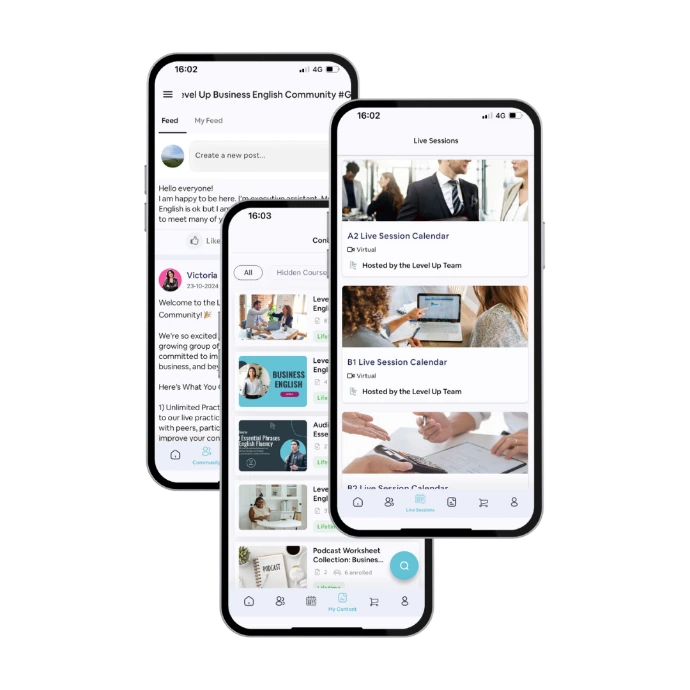
Tous vos outils pour progresser en anglais pro, réunis ici.
Exercices, fiches pratiques et support – tout dans une application conçue pour vous accompagner.
Découvrez l'application