C2234 · Professional English A1.2
30h | 11/03/2027 - 24/06/2027
Prenez la parole en anglais, enfin.
Are you starting from scratch or almost? This A1 level training gives you the basics and oral practice to start expressing yourself in English at work.
🗓️ 10/06/2026 - 02/09/2027
🕟 Thursdays, 6:30 PM - 8:30 PM
📦 30 hours, Level 1
👥 Group of 4-8 people
Course Dates:
11/03/2027, 18/03/2027, 25/03/2027, 01/04/2027, 08/04/2027, 15/04/2027, 22/04/2027, 29/04/2027, 13/05/2027, 20/05/2027, 27/05/2027, 03/06/2027, 10/06/2027, 17/06/2027, 24/06/2027

"Even starting with a beginner level, you progress quickly. It's motivating and very useful. This training is very practice-oriented. "
What you will take away from this training
The basics to express yourself
The basic structures to introduce yourself, ask questions, and respond clearly in a professional context
The vocabulary that really matters
Targeted vocabulary for the situations you actually encounter at work
Practice at every session
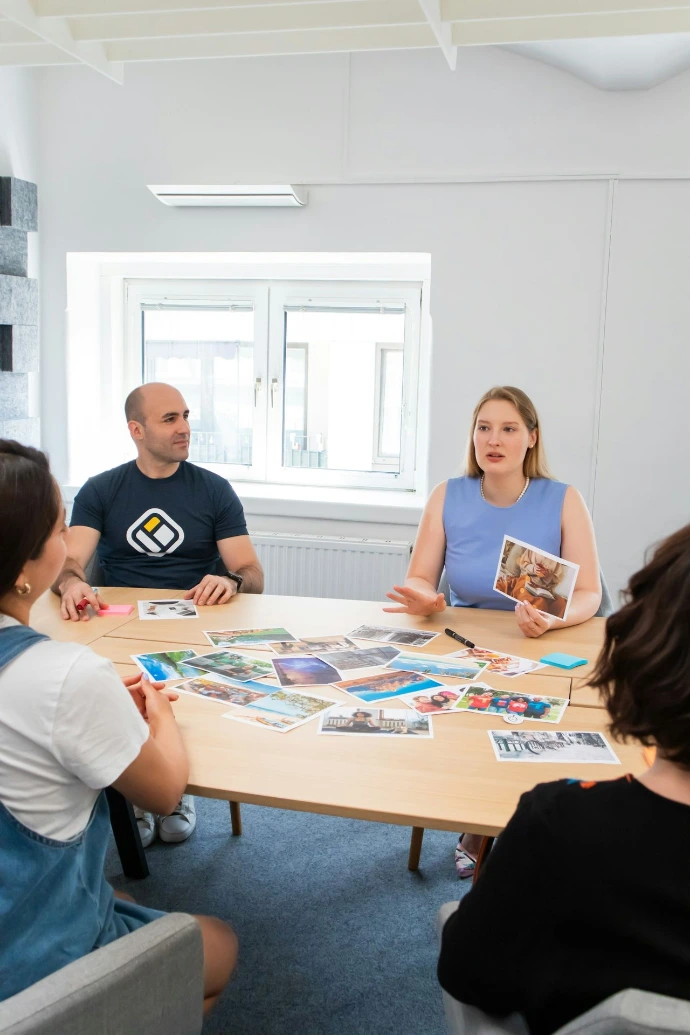
Oral practice at every session, in a small group, to dare to speak without fear of judgment
The confidence to get started
The confidence needed to no longer avoid exchanges in English
Your journey, level by level
Discover the skills you develop at each level, from the first word in a meeting to complete ease at work.
Beginner
For those starting from zero or almost. You build the necessary foundations to understand and be understood in a simple professional context.
Register- Introducing yourself, presenting your position and your company
- Numbers, dates, times, and prices
- Spelling your name and email address over the phone
- Asking closed questions (yes/no) and Wh- questions (who, what, where, when)
- Scheduling an appointment or a meeting
- Writing a short and professional email
- Describing your daily work and responsibilities
- And more!
Pre-intermediate
To consolidate the basics and gain independence. You participate in longer exchanges and manage common professional situations without preparation.
Discover available A2 level courses- Comparing options and expressing an opinion
- Vocabulary for meetings and speaking in groups
- Describe a problem and propose a solution
- Understand different accents in a professional context
- Make a structured professional call
- Write an email to request information or a deadline
- And more!
Intermediate
Pour gagner en fluidité et en précision. Vous participez activement à des réunions, défendez une idée et gérez des situations professionnelles plus complexes.
Discover the available B1 level courses- Conduct a short presentation with visual support
- Argue and nuance a point of view in a meeting
- Negotiate a deadline or a simple agreement
- Manage an informal conversation (professional small talk)
- Adapt your speech according to your interlocutor
- Understand humor and common expressions at work
- And more!
Satisfied students, concrete results
What our clients say about us.
"Honestly, I couldn't hope for better!! They are very responsive. I can already feel the difference; I feel more comfortable when I speak English."

"I have regained more confidence in speaking English and I am now able to participate in a conversation without stress or hesitation. "

"Top-notch courses given by competent and motivating trainers. I regained confidence, I progressed both in understanding and in expression. "

Everything you need to know
You will find here the answers to the questions we are most often asked before signing up.
Do I need to have a background to enroll?
How do the sessions work?
In small groups of 4 to 8 participants maximum, in person at our premises in Charleroi. Each session combines professional role-playing and oral practice, so you can speak from the very first session.
What happens if I miss a session?
Let us know as soon as possible and we will provide you with the missed content. The small group format also allows for easy catch-up during the next session.
Is this training suitable for my industry?
Yes. The content is based on general professional situations (meetings, emails, presentations, exchanges with clients or foreign colleagues) applicable to most work environments.
Can I take this training if my company funds my training?
Yes, we prepare the necessary documents (quotes, invoices, attendance certificates) for reimbursement by your employer.
What happens after this training?
You can continue your progression with the next level, or with our Level Up program to keep practicing independently.
Unit 1: What do you do at work?
Theme: Jobs and responsibilities
Objectives:
- Describe your job using simple sentences.
- Ask a colleague what they do.
- Talk about basic responsibilities.
Grammar: Present Simple consolidation
Unit 2: What does your colleague do?
Theme: Talking about other people at work
Objectives:
- Describe a colleague’s role, department and regular tasks.
Grammar: Third-person singular: he/she works, has, does, goes
Unit 3: Do you start at nine?
Theme: Working hours
Objectives:
- Talk about starting and finishing times, breaks and regular working hours.
- Ask about another person’s schedule.
Grammar: Present Simple questions and short answers
Unit 4: I don’t work on Fridays
Theme: Routines and schedules
Objectives:
- Say what you do and don’t do regularly.
- Ask simple questions about work routines.
Grammar: Present Simple affirmative, negative and interrogative forms
Unit 5: Checkpoint
Review: Units 1–4
I CAN:
- Talk about my work.
- Describe a colleague’s job.
- Explain my working hours.
- Ask and answer simple questions about routines.
Unit 6: There’s a meeting room upstairs
Theme: The workplace
Objectives:
- Describe the basic layout of a workplace.
- Say what rooms and facilities are available.
Grammar: There is / There are
Unit 7: Is there a printer near here?
Theme: Facilities and equipment
Objectives:
- Ask whether something is available.
- Say what is or isn’t available.
Grammar: Is there...? / Are there...? + some / any
Unit 8: It’s next to the kitchen
Theme: Locating things
Objectives:
- Ask where a room, person or object is.
- Give simple location information.
Grammar: Prepositions of place: in, on, under, next to, between, behind, in front of
Unit 9: How do I get to reception?
Theme: Simple directions
Objectives:
- Ask for short directions.
- Follow simple directions.
- Give simple directions inside or around a workplace.
Grammar: Imperatives and direction language: go, turn, take, stop
Unit 10: Checkpoint
Review: Units 6–9
I CAN:
- Describe a workplace.
- Ask about facilities.
- Locate things.
- Understand and give short, simple directions.
Unit 11: Whose laptop is this?
Theme: Possessions at work
Objectives:
- Ask who an object belongs to.
- Say who owns an item.
Grammar: Possessive ’s + whose
Unit 12: This one or that one?
Theme: Identifying objects
Objectives:
- Identify documents, equipment and everyday objects.
- Distinguish between different objects.
Grammar: This / that / these / those + one / ones
Unit 13: What does it look like?
Theme: Describing objects
Objectives:
- Give a basic description of an object.
- Use color, size and other simple characteristics.
Grammar: Adjective position + be
Vocabulary: Colors, size and basic descriptive adjectives
Unit 14: I have two, but I need three
Theme: Things we have and need
Objectives:
- Say what you have.
- Say what you don’t have.
- Say what you need.
- Ask someone if they have something.
Grammar: Have / has + plural nouns
Unit 15: Checkpoint
Review: Units 11–14
I CAN:
- Talk about possession.
- Identify objects.
- Describe basic characteristics.
- Say what I have or need.
Unit 16: What are you doing?
Theme: Activities happening now
Objectives:
- Say what you are doing at the moment.
- Ask what another person is doing.
Grammar: Present Continuous
Unit 17: She’s talking to a customer
Theme: People at work right now
Objectives:
- Describe what people are doing in a workplace.
- Make simple affirmative and negative statements.
Grammar: Present Continuous affirmative and negative
Unit 18: Are you using the meeting room?
Theme: Asking about current activities
Objectives:
- Ask whether someone is doing something now.
- Give short answers.
Grammar: Present Continuous questions
Unit 19: Usually I work here, but today I’m at home
Theme: Routine vs now
Objectives:
- Distinguish between something that happens regularly and something happening now.
- Talk about simple temporary situations.
Grammar: Present Simple vs Present Continuous — basic consolidation
Unit 20: Checkpoint
Review: Units 16–19
I CAN:
- Say what I and other people are doing now.
- Ask about current activities.
- Distinguish a regular routine from what is happening today.
Unit 21: Can I use this computer?
Theme: Permission
Objectives:
- Ask for simple permission.
- Give or refuse permission in everyday workplace situations.
Grammar: Can / can’t for permission
Unit 22: Can you send me the file?
Theme: Simple requests
Objectives:
- Ask someone to do something simple.
- Respond positively or negatively to a request.
Grammar: Can you...? — request consolidation
Unit 23: I need some paper
Theme: Supplies and basic needs
Objectives:
- Say what you need.
- Ask whether supplies are available.
- Request everyday workplace items.
Grammar: Need + nouns; some / any consolidation
Unit 24: How many do you need?
Theme: Quantities
Objectives:
- Ask simple questions about quantities and amounts.
- Answer questions about quantities.
Grammar: How many / How much + countable and uncountable nouns
Unit 25: Checkpoint
Review: Units 21–24
I CAN:
- Ask permission.
- Make simple requests.
- Explain what I need.
- Communicate basic quantities.
Unit 26: Did you send the email?
Theme: Completed actions
Objectives:
- Ask whether a simple task was completed.
- Give a short positive or negative answer.
Grammar: Past Simple questions with did — consolidation
Unit 27: I sent it yesterday
Theme: Recent work activities
Objectives:
- Say what you did yesterday.
- Talk simply about something you did earlier in the week.
Grammar: Past Simple — common regular and irregular verbs
Unit 28: I didn’t receive the document
Theme: Simple follow-up
Objectives:
- Say that an action did not happen.
- Explain simply what you did or did not receive, send or complete.
Grammar: Past Simple negative with didn’t
Unit 29: Was the meeting yesterday?
Theme: Simple past information
Objectives:
- Ask and answer basic questions about where or when something was.
- Give a very short description of a past event.
Grammar: Past Simple of to be: was / were
Unit 30: Checkpoint
Review: Units 26–29
I CAN:
- Ask and answer simple questions about completed actions.
- Talk briefly about something I did.
- Say what did not happen.
- Communicate basic information about a past event.




Certified quality.
Subsidized training.

LV Linguistics is Qfor certified, the quality label recognized for training organizations in Belgium. This certification attests to the quality of our pedagogy, the seriousness of our organization, and the satisfaction of our clients, based on regular audits. It also grants access to several subsidy schemes to finance your training or that of your teams, notably the training vouchers in Wallonia and Brussels. Depending on your situation, a significant part of the training cost can thus be covered.
Certified quality.
Subsidized training.
LV Linguistics is Qfor certified, the quality label recognized for training organizations in Belgium. This certification attests to the quality of our pedagogy, the seriousness of our organization, and the satisfaction of our clients, based on regular audits. It also grants access to several subsidy schemes to finance your training or that of your teams, notably the training vouchers in Wallonia and Brussels. Depending on your situation, a significant part of the training cost can thus be covered.
Meet our English team
Dedicated professionals at the service of our success

Jesse (United States)
Jesse has been teaching at LV Linguistics for many years, supporting teams in some of the largest companies in Belgium. His method: humor, oral practice, zero judgment. Result: learners who finally speak up in meetings with an ease they never thought possible.

Kat (United Kingdom)
Nurse, English teacher, and life coach, Kat has been guiding people towards their goals for over ten years. Her master's focused on access to care for non-English speaking women in the United Kingdom. She now helps healthcare professionals transition to a career in English.

Samantha (United Kingdom)
Samantha is a true gem within LV Linguistics, equally appreciated by her colleagues and her learners. Her tailored sessions combine rigor and patience: she observes, adjusts, revisits what is challenging until it becomes natural.

Victoria (Canada)
Founder and director of LV Linguistics, Victoria built the company around a simple belief: confidence is learned before grammar. She designs tailored programs based on neuroscience and oral practice, so that each learner can express themselves with ease.
Meet our English team
Dedicated professionals at the service of our success
Jesse (United States)
Jesse has been teaching at LV Linguistics for many years, supporting teams in some of the largest companies in Belgium. His method: humor, oral practice, zero judgment. Result: learners who finally speak up in meetings with an ease they never thought possible.
Kat (United Kingdom)
Nurse, English teacher, and life coach, Kat has been guiding people towards their goals for over ten years. Her master's focused on access to care for non-English speaking women in the United Kingdom. She now helps healthcare professionals transition to a career in English.
Samantha (United Kingdom)
Samantha is a true gem within LV Linguistics, equally appreciated by her colleagues and her learners. Her tailored sessions combine rigor and patience: she observes, adjusts, revisits what is challenging until it becomes natural.
Victoria (Canada)
Founder and director of LV Linguistics, Victoria built the company around a simple belief: confidence is learned before grammar. She designs tailored programs based on neuroscience and oral practice, so that each learner can express themselves with ease.

Don't let English hold back your career anymore.
A small group, intensive oral practice, measurable progress.
Reserve your spotOther events to discover
Workshops, afterworks, and upcoming information sessions at LV Linguistics.